
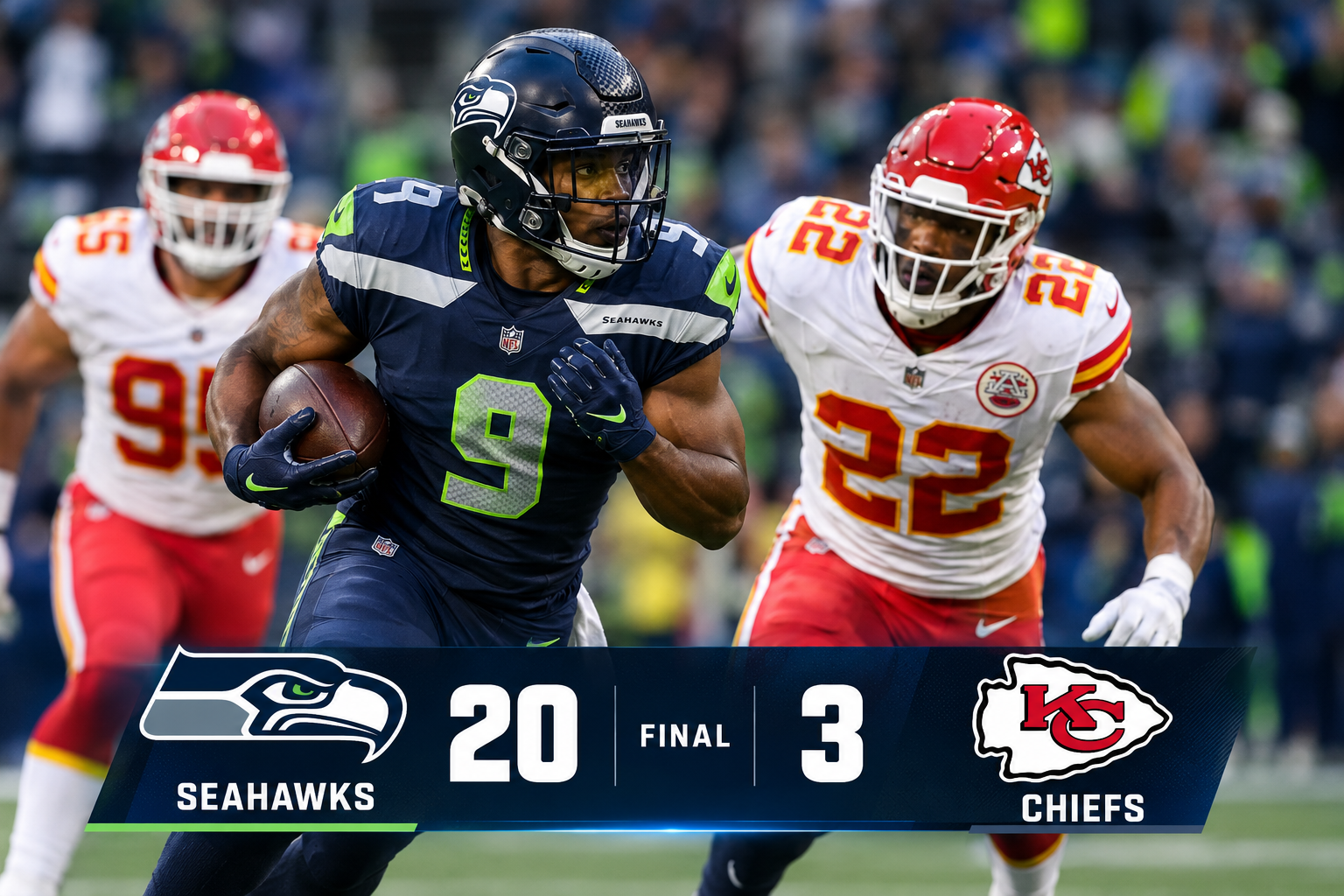
The Seahawks vs Chiefs matchup ended with Seattle securing a dominant 20-3 victory at Lumen Field on October 25, 2026. The Seahawks’ defense limited Kenneth Walker III to 36 rushing yards while holding Patrick Mahomes to 165 passing yards, handing Kansas City its first loss of the 2026 NFL season.| The Seattle Seahawks delivered one of their strongest defensive performances of the 2026 NFL season Sunday night, defeating the Kansas City Chiefs 20-3 at Lumen Field and handing Kansas City its first loss of the year. Seattle’s defense controlled the matchup against a Chiefs offense that had entered Week 7 undefeated. Former Seahawks running back Kenneth Walker III, who arrived in Seattle with 665 rushing yards through his first five games with Kansas City, managed only 36 yards on 14 carries. The Seahawks also limited quarterback Patrick Mahomes to 165 passing yards, intercepted one of his passes and prevented Kansas City from scoring a touchdown. While Walker’s return to Seattle attracted considerable attention, the result was about much more than one running back. Seattle won the battle for field position, restricted Kansas City’s offensive production and received important contributions from both its passing and rushing attacks.
Seahawks vs Chiefs: How Seattle’s Defense Controlled the Game
The Seahawks vs Chiefs game highlighted Seattle’s defensive strength against one of the NFL’s most dangerous offenses. By limiting Kansas City’s rushing production and keeping Patrick Mahomes out of the end zone, Seattle controlled the matchup and secured a convincing victory. The final score reflected a difficult night for the Chiefs’ offense. Kansas City finished with 213 total yards, compared with Seattle’s 410. The Chiefs recorded just 11 first downs and converted three of 11 third-down opportunities, according to the Seahawks’ official game recap. Mahomes completed 19 of 33 passes for 165 yards, with no touchdown passes and one interception. Kansas City managed only a 50-yard field goal by Harrison Butker for its lone score. Seattle’s defensive success was particularly notable because the Chiefs had started the season 5-0. Kansas City had demonstrated the ability to move the ball consistently during that stretch, making Sunday’s limited production a significant departure from its earlier results. The Seahawks improved to 4-3 with the victory, recovering from a difficult stretch in which they had lost two consecutive games.
Seattle’s Run Defense Wins the Key Matchup
Walker entered the game as one of the NFL’s most productive runners. His 665 rushing yards through five games had made him a central part of Kansas City’s offensive attack. Against Seattle, however, he struggled to find room to operate. His 14 carries produced 36 yards, an average of approximately 2.6 yards per attempt. He also caught four passes for 21 yards, according to the game statistics. Seattle extended its streak without allowing an individual 100-yard rusher to 36 consecutive games, including the postseason. That achievement reflects a sustained defensive strength rather than a one-game accomplishment. Against Kansas City, the Seahawks maintained that standard against a back who had been producing at an exceptional rate during the opening weeks of the season. The key takeaway is that Seattle limited the effectiveness of a major component of Kansas City’s offense. With Walker unable to generate his usual rushing production, the Chiefs had to find other ways to sustain drives and create scoring opportunities.
Patrick Mahomes Cannot Find an Offensive Breakthrough
Containing Walker was only part of Seattle’s defensive performance. The Seahawks also made life difficult for Mahomes, who finished without a passing touchdown. His interception helped Seattle establish control of the game, while Kansas City’s limited production prevented the visitors from mounting a sustained comeback. The Chiefs’ overall numbers illustrate the problem. Their 213 total yards were less than 52% of Seattle’s offensive output, leaving a substantial gap between the teams. Mahomes still completed 19 passes, but the offense struggled to translate its possessions into meaningful scoring opportunities. Kansas City’s only points came from Butker’s field goal. Seattle’s performance also demonstrated the value of limiting explosive plays and forcing an opponent to work through difficult situations. Against a quarterback capable of changing a game quickly, keeping Kansas City out of the end zone was especially important. For the Chiefs, the challenge is not simply finding a way to get Walker more carries. The passing game must also provide enough production to prevent opposing defenses from concentrating their attention on the rushing attack.
Jaxon Smith-Njigba and Emanuel Wilson Deliver for Seattle
Seattle’s offense supplied the production needed to turn its defensive advantage into a convincing victory. Wide receiver Jaxon Smith-Njigba recorded nine receptions for 150 yards and a touchdown. His performance gave quarterback Sam Darnold a reliable target and helped Seattle generate big plays throughout the game. Darnold completed 20 of 28 passes for 257 yards and one touchdown. He also contributed with his legs, helping the Seahawks maintain drives when passing opportunities were limited. Running back Emanuel Wilson provided another important contribution. He carried the ball 24 times for 100 yards and scored on a 21-yard run in the fourth quarter. Wilson’s touchdown extended Seattle’s lead to 17 points and effectively put the game out of reach. The contrast between the two rushing performances was striking. Wilson reached the 100-yard mark while Walker finished with only 36 rushing yards. Seattle did not need its offense to produce an extraordinary number of points. Instead, the combination of consistent offensive gains and defensive control was enough to maintain a comfortable advantage.
What Kenneth Walker III’s Return Means for the Chiefs
Walker’s return to Seattle added an emotional dimension to an otherwise straightforward game result. He had previously played for the Seahawks before joining Kansas City, making Sunday’s matchup an opportunity to face his former team on its home field. The reunion did not go as planned for the running back. His rushing total was his lowest of the season to that point, and Seattle prevented him from generating the long runs that had helped establish him as one of the league’s leading rushers. Walker also left the field without greeting his former teammates, according to multiple reports. He attributed his reaction to frustration following the defeat. That moment should not be mistaken for evidence of a broader dispute. Competitive disappointment after a difficult game does not, by itself, establish tension between a player and his former teammates. From a football perspective, the more important question is how Kansas City responds to the defensive approach Seattle used. The Chiefs need to maintain balance between their running and passing games. When an opponent limits the ground attack, the passing game must create enough consistent production to prevent the defense from committing additional resources to stopping the run. Mahomes acknowledged the need for the offense to support Walker more effectively, according to multiple reports. That is a useful framework for understanding the problem: Kansas City must improve as a unit rather than expect its running back to solve every difficult situation.
What the Loss Means for Kansas City
The defeat dropped Kansas City to 5-1, ending its unbeaten start to the season. One loss does not erase the team’s strong opening stretch, but the manner of Sunday’s defeat provides clear areas for improvement. The Chiefs produced only three points, recorded 213 total yards and failed to score a touchdown. Those figures point to a broader offensive problem than Walker’s individual statistics alone can explain. Kansas City must examine how it handles defensive pressure, sustains third-down conversions and creates opportunities when its primary rushing option is contained. The team’s personnel absences also formed part of the pregame context, as pregame reporting noted injuries affecting the offensive line and receiving group. Those absences may have complicated the offensive plan, although they do not change the final statistical result. The next test will be whether Kansas City can restore its offensive rhythm against its upcoming opponents. For a team that began the season with five consecutive victories, the immediate priority is to treat the loss as an opportunity to identify weaknesses rather than as evidence that the entire offense is broken.
Readers can follow the Seattle Seahawks’ official website and NFL.com for official team updates, game reports and league statistics.
Seahawks Gain Momentum From a Complete Team Performance
Seattle’s victory offered an important response after consecutive defeats. The defense held a previously unbeaten opponent to three points, while the offense produced 410 total yards and received standout performances from Smith-Njigba and Wilson. The result also reinforced Seattle’s ability to win in different ways. Its defense controlled the game’s most important matchup, and its offense did enough to build and protect a lead. There are still areas for the Seahawks to address. Their 20-point total was lower than their offensive yardage might suggest, and their scoring efficiency inside the red zone remains an area for improvement, according to the team’s official recap. Even so, holding Kansas City to a single field goal was a major accomplishment. The most significant lesson from Sunday’s game is that Seattle did not rely on one player or one sequence to secure the result. It combined defensive discipline, offensive production and effective game management to defeat a previously undefeated opponent. For Kansas City, the loss raises questions about offensive adaptability. For Seattle, it provides evidence that its defense can disrupt one of the NFL’s most dangerous offenses. The Seahawks will look to carry that performance into their next game, while the Chiefs must find a way to rebound and restore the balance that powered their successful start to the season. For more coverage, explore our latest NFL news, game recaps and team analysis on US Sports Media.